
If the Sex Pistols, The Clash or Ramones are the first names to come to mind when we talk about the punk movement, it's important to remember the feminine figures pioneers of this movement, who are all too often sidelined.
Picture by: Pat Graham
Post-hippie, punk is a movement associated with a certain masculinity. It conveys the image of a thug who breaks the rules and flouts the law like a delinquent. For women, being a punk was seen as a massive transgression, and was much less well received by the public and society. Indeed, in their eyes, a woman who makes too much noise is even worse than a man who makes too much noise.
Yet it is precisely this “half-assed”, rebellious side that paved the way for women to get on stage. By championing amateurism, poor playing, shoddy sound systems, shouting and singing out of tune, punk encouraged female audience members to give it a go. Unlike young men, who were more likely to have had a musical education enabling them to play the guitar or drums, women were in no way encouraged down this path, and were in fact deliberately kept very far away from it. So all of a sudden, with a movement that required no skill whatsoever and, on the contrary, encouraged you not to give a damn and just go for it, this was one of the first times women could feel entitled to step onto the stage.
Bringing a sense of electric freedom and a passion never seen before, women formed the rebellious roots of the movement. Driven by anger and a desire to break free from the boxes and roles imposed by a misogynistic and conservative society, punk took root and gained strength with a determination characteristic of feminine rage.
Patti Smith and Horses
Pioneers such as Patti Smith, with her fabulous album Horses, had already paved the way, proving that it was possible for women to make their mark in the male-dominated world of rock music. Born in 1946 into a modest family and raised in a small town in New Jersey, Patti Smith moved to New York at a very young age. There she met Robert Mapplethorpe, with whom she shared a very powerful and close relationship (see Just Kids, her autobiography of her years in New York). They managed to live by selling a few of their artworks and articles written for music magazines (such as Creem or Rolling Stone), while staying at the Chelsea Hotel, a legendary venue where she met many influential artists of the 1960s and 1970s underground scene, such as Janis Joplin and Jimi Hendrix. They also frequented CBGB, the essential venue for the birth of punk, where bands such as the Ramones, Television and Blondie played their first gigs.
Patti Smith released Horses in 1975, an album that remains a classic to this day, instantly recognisable thanks to its legendary cover photograph taken by her friend Robert Mapplethorpe. In the style of Frank Sinatra, she has a black jacket slung over her shoulder and her gaze fixed on us.
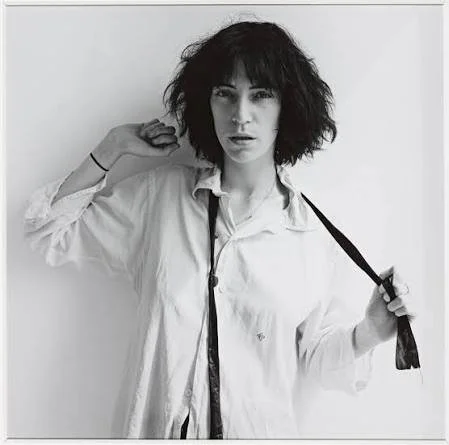
© Robert Mapplethorpe
The album opens with the line “Jesus died for somebody’s sins but not mine”. The tone is set: it’s a declaration of rebellion, youth and freedom, a rejection of authority. She asserts her own unique freedom by weaving her poetry into the music, opening up her entire artistic spirit.
With her androgynous style, jet-black hair and white shirts, she does not seek to alter her appearance to please the male gaze; she presents herself as she is, breaking free from social conventions. It is a question of freedom, self-assertion and poetry.
Horses is therefore definitely a gateway into the punk movement. An impressed Viv Albertine said that it encouraged her to pick up the guitar with The Slits: “The girls have shown so much self-control and restraint up to now; Patti Smith lets herself go. It would be liberating if I could find within myself even a quarter or an eighth of what she has, and not give a damn about looking ridiculous, then I might still have a chance of making something of my life.”
Siouxsie Sioux, the Godmother of Punk
How can one talk about punk without mentioning its godmother, Siouxsie Sioux? Born Susan Janet Ballion in London in 1957, she turned to music as an escape following a series of traumatic events in her youth. She met Steven Severin (born Steven John Bailey), John McKay and Kenny Morris (Kenneth Ian Morris), with whom she formed her legendary band, Siouxsie and the Banshees, in 1976. Initially, their drummer was not Kenny Morris but a certain Simon Ritchie, who would later become famous as Sid Vicious of the Sex Pistols.
Siouxsie Sioux stood out even before she sang, with such a distinctive and assertive look that she immediately caught the eye. With accessories and outfits drawn from BDSM and bondage, she embodied an alternative form of femininity and a level of provocation unprecedented at the time, which caused quite a stir. She was part of the “Bromley Contingent”, the founding core of British punk, and so spent a great deal of time with the Sex Pistols and at the SEX shop run by Vivienne Westwood and her partner Malcolm McLaren, who was none other than the Sex Pistols’ manager (a relationship to which we could actually devote an entire article).
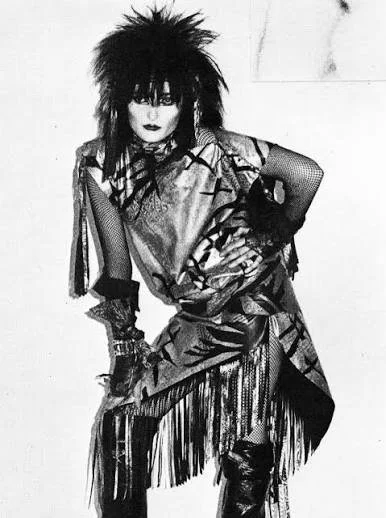
© Jill Furmanovsky
In 1978, the band released their first single, “Hong Kong Garden”, which was a huge success and led to the release of the album The Scream, one of the fundamental albums of the post-punk era. Undoubtedly a pioneer of the London punk scene, Siouxsie Sioux also paved the way for the Riot Grrrl movement. As one of the first women to command respect on stage, to refuse to be pushed around and to assert a personality that defied convention, she was a huge inspiration to the punk rock scene right from the start.
Riot Grrrl: “A More Feminist Punk and a Feminist More Punk”
Riot Grrrl is an underground punk rock and feminist movement that emerged in the early 1990s in the north-west of the United States. It was born out of a reaction against the pervasive sexism of the male-dominated punk rock scene of the time, where women were often relegated to the roles of spectators, muses or groupies. The term “grrrl” reflects a desire to reclaim an identity: to feel more empowered by being a girl than by having to live up to the expectations associated with being an adult woman.
The name that immediately comes to mind is, without a doubt, Bikini Kill. Formed in October 1990, the band is regarded as a forerunner of the Riot Grrrl movement. Despite some progress, women continued to be marginalised within the punk scene, and many were subjected to abuse. As Tobi Vail, founder of the fanzine Jigsaw, explained: “Because punk rock is for and by boys.”
Kathleen Hanna shared this sentiment and produced her own zine (a small, self-published print magazine) entitled Bikini Kill. Alison Wolfe and Molly Neuman were also working on a zine supporting the feminist cause in music. Together, they decided to fight the misogynistic punk community. Vail and Hanna then joined Billy Karren and Kathi Wilcox to form the band Bikini Kill, which went on to enjoy great success, notably with their hit “Rebel Girl”. The title says it all: this song, which literally calls for a revolution and has queer undertones, shook up a society that remains patriarchal and opposed to any real liberation of women.
“WHEN SHE TALKS I HEAR THE REVOLUTION [...] IN HER KISS I TASTE THE REVOLUTION.”
Deeply radical, Bikini Kill inspired numerous all-female punk bands in the 1990s, 2000s and 2010s. Today, this legacy can be seen in artists and bands such as Fiona Apple, Pussy Riot and White Lung. The liberation of bodies, voices and identities remains at the heart of this feminist and punk tradition.
The Slits and Beyond
We could also mention The Slits, one of the leading bands of the women’s punk movement. Consisting of Viv Albertine, Palmolive, Tessa Pollitt and Ari Up, they were among the most provocative figures on the punk scene, starting with their name. Their chaotic look echoed the defiant style of The Stooges. They were among the first female rock musicians to assert themselves with such personality and confidence. Their legacy lives on today through artists such as Madonna and Björk.
We could mention many more female figures who were part of and helped shape the punk movement, such as Bratmobile or X-Ray Spex. This is not a question of superiority or of questioning the talent of male bands such as the Ramones or The Clash, but rather an expression of gratitude and a tribute to all the women who have been all too quickly sidelined from the conversation, yet who, through their uniqueness, their talent and their truly rebellious spirit, have left an indelible mark on the history and identity of music.
Because even anti-system movements such as punk continue to perpetuate the mechanisms that render women invisible, are there, then, only women rebellious enough to turn the tables, and the stage?